Site D · Cards · West plateau
Survey Grid
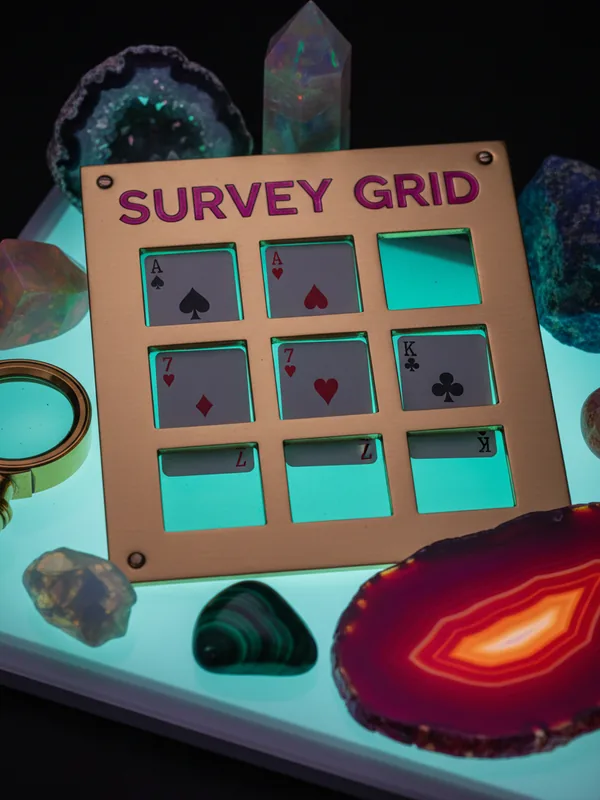
Nine cards, one at a time, onto a three-by-three grid. Every row, column and diagonal is read as a three-card hand, so each square you choose counts several times.
- Bearing
- 288°
- Range
- 5.2 km
- Elevation
- 500 m
Played for ink only · no cash value · 18+

Pick a stake, then press the button. Ink has no cash value.
The games are paused on this device.
The almanac, your logbook and Base Camp stay open. See your settings.
About Survey Grid
Survey Grid is a placing game for one. A shuffled pack deals you nine cards, one at a time, and each one must go on an empty square of a three-by-three grid before you see the next. When the grid is full, the eight lines through it, three rows, three columns and two diagonals, are each read as a three-card hand.
The centre square sits on four lines, the corners on three and the edges on two, so where a card goes matters as much as what it is. A pair placed on a corner and the centre can feed a row, a column and a diagonal at the same time. A card that fits nowhere is best parked where it spoils the fewest lines.
The hands are simple: a pair, three of one suit, three in a run, three of a kind, or a run in one suit. Each line scores points and the round returns a multiple of your stake from the points total. If you want a second opinion, Suggest a square marks the square our helper would pick, and Finish for me places the rest of the cards the same way.
Field key: how to play
- Pick a stake: 10, 25, 50, 100 or 250 ink, then press Deal.
- The card in hand goes on any empty square. Then the next card is turned.
- When all nine squares are full, each of the eight lines (rows, columns, diagonals) scores: pair 1, three of one suit 2, run 3, three of a kind 6, run in one suit 8. Ace counts high or low in a run (A-2-3 and Q-K-A both count).
- The total of the eight lines sets the return from the key below, as a multiple of your stake.
- Suggest a square marks a sensible square for the card in hand. Finish for me places every remaining card with the same advice.
Returns
Every return is a multiple of what you staked. Ink has no cash value and nothing on Carthoryn can be exchanged for anything.
| Hand | Points |
|---|---|
| Pair | 1 |
| Three of one suit | 2 |
| Run of three | 3 |
| Three of a kind | 6 |
| Run in one suit | 8 |
| Total | × stake |
|---|---|
| 0–5 points | 0 |
| 6–7 points | 0.5× |
| 8–9 points | 1× |
| 10–11 points | 2× |
| 12–13 points | 4× |
| 14–16 points | 7× |
| 17–19 points | 18× |
| 20–23 points | 50× |
| 24+ points | 150× |
Fair play
Every result comes from your browser's random number generator, through the rules on this page and nothing else. There is no balancing, no memory of earlier rounds and no change in the odds after a quiet patch or a lively one. The game reads the same numbers that are printed above.
Questions
Is the helper the best possible play?
It is a good, simple rule of thumb: it favours squares that keep the most lines promising. A careful player can sometimes do better, and a hasty one will often do worse.
What happens if I leave mid-grid?
The round is lost with the stake already placed. Use Finish for me if you need to go.
Does the pack remember previous rounds?
No. Every round shuffles a full pack of 52 cards from scratch.